


Dr. Sebi talked about how he used Seh-haw to remove a tumor from Michael jackson’s son head.
| Category | Detail |
| Scientific Name | Combretum micranthum G. Don |
| Family | Combretaceae |
| Synonyms | Combretum altum, C. floribundum (Botanical) |
| Common Names | Kinkeliba (Widely used), Seh-haw (Wolof, Senegal/Gambia), Health Tree, Tisane de longue vie (Infusion of long life). |
| Part Used | Leaf (Folium Combreti), and sometimes the stem bark or roots. |
| Habitat | Native to West Africa, found in the Sudano-Sahelian zone, including Senegal, Mali, Burkina Faso, Guinea, Niger, and The Gambia. |
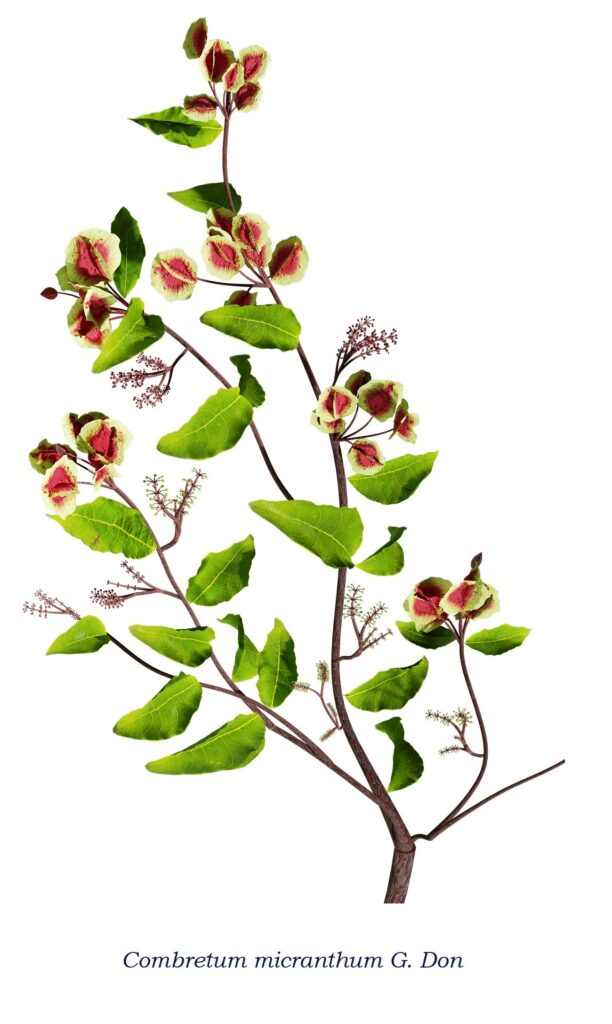
Phytochemistry (Chemical Composition)
Seh-haw leaves are particularly rich in a diverse array of bioactive compounds, contributing to its traditional medicinal uses.
- Flavonoids/Polyphenols: These are the primary constituents responsible for much of its activity. Key compounds include:
- Vitexin and Isovitexin (C-glycosylflavones)
- Catechins and other Flavans
- Quercetin derivatives
- Tannins: Contribute to its astringent and potential anti-diarrheal properties.
- Alkaloids: Including a newly reported class called kinkéloids (flavan-piperidine alkaloids), which have shown potential in anti-diabetic activity.
- Phenolic Acids
- Minerals: Contains essential minerals such as Potassium, Magnesium, Calcium, Iron, and Zinc.
Traditional & Ethnobotanical Uses
For centuries, Seh-haw has been one of the most popular bush teas in West Africa, often consumed daily as a tonic or for specific ailments.
- Hepato-Biliary & Digestive Aid: This is its most prominent traditional use. It is employed as a:
- Choleretic (stimulates bile production in the liver) and Cholagogue (stimulates bile flow from the gallbladder).
- Digestive aid for stomach upset, indigestion, and relieving bloating.
- Traditional remedy for jaundice, hepatitis, and other liver disorders.
- Detoxification & Diuresis: Used as a mild diuretic and purifying/detoxifying agent, especially important for breaking the fast during Ramadan (known for its pleasant, slightly woody flavor).
- Fever & Infection: Used traditionally to treat fevers, including those associated with malaria, colds, and flu. Extracts show antimicrobial activity against certain bacteria (Staphylococcus, E. Coli).
- Cardiovascular: Used to help normalize and lower blood pressure (Antihypertensive).
Pharmacological & Research Data
Modern studies support many of the traditional applications and identify mechanisms of action:
| Activity | Research Findings |
| Antioxidant | High polyphenol content provides significant free-radical scavenging capacity. |
| Anti-inflammatory | Demonstrated an ability to inhibit inflammatory mediators and reduce inflammation in animal models (e.g., against induced paw edema) and in skin cells. |
| Hepatoprotective | Studies confirm its protective effect on liver cells and its ability to stimulate bile flow, validating its use in liver disorders. |
| Antidiabetic | Extracts show a glucose-lowering effect by inhibiting a biological compound (PEPCK) involved in glucose production in the liver. The novel kinkéloid alkaloids may play a role. |
| Skin Health | Extracts rich in vitexin and isovitexin have shown UV-protective, antioxidant, and anti-inflammatory effects in skin cells, suggesting potential for treating skin inflammation and “inflammaging.” |

Safety and Precautions
| Category | Detail |
| General Safety | Considered possibly safe when consumed as a traditional tea for up to six months. Generally reported to have very low toxicity. |
| Side Effects | Mild side effects may include stomach pain in some individuals. |
| Contraindications | Pregnancy and Breast-feeding: Due to a lack of reliable safety information, avoidance is advised. |
| Drug Interactions | Moderate Interactions are possible with: Antidiabetic Drugs: May cause blood sugar to drop too low (additive effect). Antihypertensive Drugs: May cause blood pressure to drop too low (additive effect). Diuretic Drugs (Water Pills): May cause potassium levels to drop too low (additive effect). |
| Category | Detail |
| General Safety | Considered possibly safe when consumed as a traditional tea for up to six months. Generally reported to have very low toxicity. |
| Side Effects | Mild side effects may include stomach pain in some individuals. |
| Contraindications | Pregnancy and Breast-feeding: Due to a lack of reliable safety information, avoidance is advised. |
| Drug Interactions | Moderate Interactions are possible with: Antidiabetic Drugs: May cause blood sugar to drop too low (additive effect). Antihypertensive Drugs: May cause blood pressure to drop too low (additive effect). Diuretic Drugs (Water Pills): May cause potassium levels to drop too low (additive effect). |
Recipes
Traditionally, Seh-haw is prepared as a decoction (meaning the leaves are boiled, not just steeped), which is essential to extract the maximum amount of active compounds, like the flavonoids and minerals, from the woody leaves.
Here is the traditional preparation method for Seh-haw (Kinkeliba) tea, which is often consumed strong and hot, particularly for breakfast or to break the fast during Ramadan.
Traditional Seh-haw (Kinkeliba) Tea Preparation
Method: Decoction
This method ensures a rich, dark, and potent brew, sometimes referred to as the “Infusion of Long Life” (Tisane de longue vie).
| Component | Quantity | Notes |
| Dried Seh-haw Leaves | 1−2 Tablespoons | Use approximately to grams per liter. The amount is adjusted based on desired strength. |
| Water | Liter (approx. cups) | Clean, potable water. |
1. The Boiling Stage (Decoction)
- Combine: Place the dried Seh-haw leaves and water into a saucepan.
- Boil: Bring the mixture to a rolling boil over medium-high heat.
- Simmer: Once boiling, reduce the heat and allow it to gently simmer for 8 to 15 minutes. Traditional methods often involve a longer simmer time to fully extract the beneficial compounds.
2. The Infusion Stage (Steeping)
- Remove from Heat: Turn off the heat and cover the pot.
- Infuse: Let the mixture steep for an additional 5 to 20 minutes (or even longer for a medicinal tonic). The tea should develop a dark, coppery brown color.
- Strain: Pour the liquid through a fine-mesh strainer or sieve into a teapot or cups to remove the spent leaves.
3. Serving & Customization
The tea has a pleasant, slightly woody and earthy flavor with a natural, subtle sweetness. It is typically served hot.
- Sweetener: It is very common to add sugar or honey to taste, especially when consumed as part of a meal.
- Flavor Enhancements: To balance the deep, earthy flavor, people often add:
- Mint leaves (Nana mint)
- Slices of Lime (to brighten the flavor)
- Ginger
- Cloves
Traditional Tip
One common practice in West Africa is to reuse the leaves up to 2-3 times, as the plant material is quite robust and continues to release its flavor and active ingredients on subsequent boils.
References
- Tine, Y., et al. (2024). Combretum micranthum G. Don (Combretaceae): A Review on Traditional Uses, Phytochemistry, Pharmacology and Toxicology. Chemistry & Biodiversity, 21(5). (A recent, comprehensive review summarizing all aspects of the plant.)
- Kerharo, J. & Adam, J.G. (1974). La Pharmacopée Sénégalaise Traditionnelle : Plantes Médicinales et Toxiques. Vigot Frères, Paris. (A foundational text detailing the traditional uses in Senegal, including its importance for liver disorders and as a Ramadan tonic.)
- Iwu, M. M. (1993). Handbook of African Medicinal Plants. CRC Press, Boca Raton, FL. (Provides general botanical and medicinal use descriptions across the continent.)
- Wojtyła, A. et al. (2024). Combretum micranthum G. Don – an African miracle of traditional herbal medicine. Acta Universitatis Lodziensis. Folia Botanica. (Focuses heavily on its extensive history in folk medicine and therapeutic applications.)
- Welch, C., et al. (2017). Bioactive polyphenols in kinkéliba tea (Combretum micranthum) and their glucose-lowering activities. Journal of Food and Drug Analysis, 25(2), 295-303. (Details the identification of glycosylflavones like vitexin and isovitexin, and is often cited for its anti-diabetic findings.)
- Hu, S., et al. (2023). Kinkéliba (Combretum micranthum) Leaf Extract Alleviates Skin Inflammation: In Vitro and In Vivo Study. Molecules, 28(4), 1805. (Highlights the role of vitexin and isovitexin in anti-inflammatory and skin-protective activities.)
- Welch, C., et al. (2020). Antidiabetic Agents From Leaves of Combretum micranthum (Kinkeliba). Rutgers Technology Transfer Summary. (Describes the isolation and anti-diabetic activity of the novel flavan-piperidine alkaloids (kinkéloids) from the leaves.)
- Tine, Y., et al. (2024). Combretum micranthum G. Don (Combretaceae): A Review… (This review supports the hepatoprotective activity and cholagogue effect based on multiple studies.)
- Djimeli, M. N. A. et al. (2021). In vivo Hepatoprotective Effect of Combretum micranthum Leave Extract. ResearchGate. (Specific study demonstrating its preventive effect against paracetamol-induced hepatotoxicity in animal models.)
- Chika, A. & Bello, S. O. (2010). Antihyperglycaemic activity of aqueous leaf extract of Combretum micranthum (Combretaceae) in normal and alloxan-induced diabetic rats. Journal of Ethnopharmacology, 129(1), 34-37. (A key study demonstrating its traditional use in blood sugar regulation.)
- Welch, C., et al. (2017). (Cited above). (Links the glucose-lowering activity to the inhibition of the PEPCK, in the liver.)
- Hu, S., et al. (2023). (Cited above). (Demonstrates its anti-inflammatory mechanism through the reduction of pro-inflammatory cytokines and inhibition of oxidative stress in skin cells.)
- Nguelefack, T. B., et al. (2023). Ethanolic Extract of Kinkeliba (Combretum micranthum), Rich in Phenolic Compounds Mitigates DSS-Induced Ulcerative Colitis in C57BL/6 Mice via Antioxidation and Microbiota Regulation. Molecules, 26(23), 11299. (Showcases its anti-inflammatory effects in a model of inflammatory bowel disease.)