

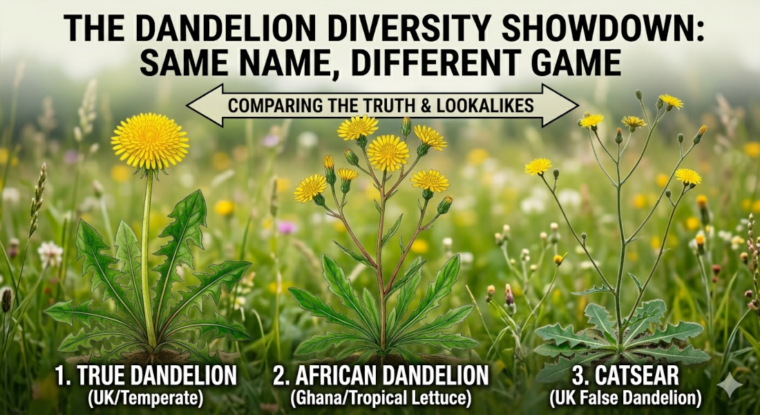


Many plants worldwide share the common name “dandelion,” but they aren’t always the same species. This is a classic case of botanical confusion: what people call “dandelion” in Europe, North America, and parts of Africa often refers to three distinct plants, each with unique properties, traditional uses, and benefits.
A few years ago in the United Kingdom, I profiled the classic dandelion – it seemed to thrive everywhere, brightening lawns and fields. I also encountered cat’s ear (often called “false dandelion”), a frequent look-alike. Later, in Ghana, I noticed another plant commonly referred to as “dandelion.” While it belongs to the same Asteraceae (daisy) family, it’s a clearly different species.
Accurate identification is essential in herbalism and foraging. Even plants in the same family with similar appearances can have different chemical profiles and primary actions. Substituting one for another based solely on looks can lead to disappointing results or unintended effects.
For example, a traditional European recipe specifying Taraxacum officinale (true dandelion) shouldn’t automatically use the African plant Launaea taraxacifolia (often called African dandelion). Neither is “superior” – they simply excel in different areas. Likewise, Hypochaeris radicata (cat’s ear or false dandelion) is often mistaken for the true species but provides milder effects.
This post compares these three commonly confused plants: the true European/American dandelion, the African dandelion, and the widespread look-alike cat’s ear. Understanding their differences helps ensure safer, more effective choices for nutrition, medicine, or foraging.

Quick Field Identification: How to Tell These Plants Apart
Yellow flowers make them easy to confuse at first glance, but reliable features help distinguish them in the wild:
- True European/American Dandelion (Taraxacum officinale)
- Single flower per stem
- Hollow flower stem (snap it – milky latex flows)
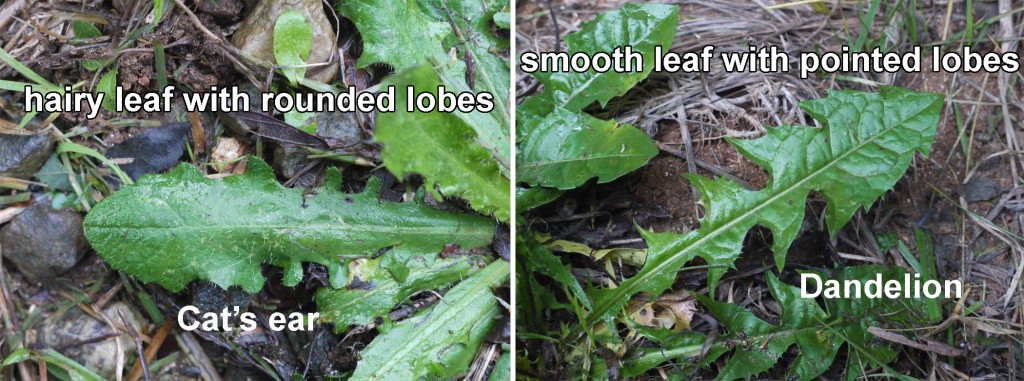
- Leaves form a flat basal rosette, smooth (hairless), deeply toothed/lobed (“lion’s tooth” shape)
- Classic round white puffball seed head
- Rule of thumb: One flower on a hollow stem + iconic puffball = true dandelion.
- African Dandelion (Launaea taraxacifolia)
- Leaves more upright, larger, thicker, broader (vegetable-like growth)
- Flowers dandelion-like, but plant rarely forms classic puffball seed head
- Often cultivated or gathered as a leafy green in West Africa (Ghana, Nigeria, Benin)
- Stems more upright/solid; no dense hairs.
- False Dandelion / Cat’s Ear (Hypochaeris radicata)
- Leaves hairy/fuzzy (like a cat’s ear – quick giveaway!)
- Flower stems branched, solid (not hollow), often multiple flowers per stem
- Puffball seed head present but usually smaller
- Widespread in temperate regions worldwide.
Quick Identification Summary Table
| Feature | True Dandelion (Taraxacum officinale) | African Dandelion (Launaea taraxacifolia) | False Dandelion / Cat’s Ear (Hypochaeris radicata) |
|---|---|---|---|
| Scientific Name | Taraxacum officinale | Launaea taraxacifolia | Hypochaeris radicata |
| Native/Primary Region | Europe, naturalized globally | West Africa | Europe, widespread temperate zones |
| Flower Stems | Hollow, single flower | Upright/solid, usually single | Solid, branched, multiple flowers |
| Leaf Texture | Smooth, hairless, deeply toothed | Thicker, broader, smooth | Hairy/fuzzy |
| Puffball Seed Head | Yes, classic round | Rare/absent | Yes, but smaller |
| Main Traditional Role | Detox herb (liver/kidney) | Nutrient-rich vegetable + medicinal | Mild wild edible/herb |
Tip for Readers: Examine multiple features together – leaves, stems, flowers, growth habit. Snap a stem to check hollowness, feel for hairs, and look for the puffball.
1. True European/American Dandelion
Scientific name: Taraxacum officinale
The iconic “true” dandelion, widely recognized and naturalized across Europe, North America, and beyond.
Key Characteristics
- Bright yellow flower heads
- Iconic round white puffball seed heads
- Flat rosette of smooth, deeply lobed leaves
- Hollow stems with milky latex
Traditional Herbal Uses Prized in European herbal traditions as a powerful detoxifier and bitter tonic, with well-documented benefits for both liver and kidney systems.
- Supporting liver and gallbladder function (a classic cholagogue and hepatic tonic)
- Acting as a potent diuretic (increasing urine output, flushing the urinary tract, helping reduce fluid retention/edema – often regarded as one of nature’s “kidney cleansers”)
- Supporting kidney and renal health through gentle diuresis, electrolyte balance (high natural potassium prevents depletion, unlike some synthetic diuretics), and mild protective effects against oxidative stress
- Stimulating digestion via bitter compounds
- Supporting metabolic health
A pilot human study (2009) found that an ethanolic extract of dandelion leaf significantly increased urination frequency and fluid excretion in healthy adults, confirming its traditional diuretic promise. Animal studies also suggest protective effects on kidneys in models of stress or toxicity.
Parts Used
- Leaves: Strongest diuretic and nutritive (rich in minerals; ideal for kidney/urinary support)
- Roots: Liver tonic, often roasted for coffee-like beverages
- Flowers: Wines, syrups, or salads
2. African Dandelion
Scientific name: Launaea taraxacifolia (also known as wild lettuce, African lettuce, or efo yanrin in Yoruba)
A staple leafy green in West Africa (Nigeria, Ghana, Benin), valued more for nutrition than pure detox.
Key Characteristics
- Yellow flowers resembling dandelion
- Larger, thicker, upright-growing leaves
- No classic puffball seed head typically
- Vegetable-like habit, often harvested young
Traditional and Emerging Uses
Primarily a nutritious vegetable with supportive medicinal roles in West African traditions.
- Supporting blood health (e.g., anti-anemic, mineral-rich)
- Helping regulate blood sugar (emerging antidiabetic research)
- Antioxidant and anti-inflammatory effects
- Traditional use for skin conditions, childhood illnesses (e.g., measles), wound healing, eye issues, and strengthening children’s bones
- Some studies show benefits in hypertensive models, including reduced oxidative stress and improved kidney biomarkers (e.g., lower creatinine/urea)
Culinary Use
Widely cooked as a leafy green in soups, stews, sauces, or eaten raw. Rich in calcium, potassium, iron, magnesium, and phytochemicals (flavonoids, tannins).

3. False Dandelion (Cat’s Ear)
Scientific name: Hypochaeris radicata
One of the most frequent dandelion imposters, common in Europe, North America, Africa, Australia, and temperate zones.
Key Characteristics
- Yellow dandelion-like flowers
- Hairy leaves (cat’s ear texture)
- Branched, solid flower stems (multiple flowers possible)
- Smaller puffball seed heads
Traditional Uses
Milder than true dandelion; edible and occasionally medicinal.
- Gentle digestive and liver support
- Mild diuretic and urinary tract support in some folk traditions (e.g., for kidney problems, fluid retention, or UTIs)
- Occasional use for constipation, rheumatism, or gallbladder issues
Edibility
Fully edible (young leaves less bitter/fibrous), though often more bitter and hairy than true dandelion. Use in salads, cooked greens, or teas.
Why Substituting Look-Alike Herbs Can Be a Problem
Precision matters in herbal medicine. Similar-looking Asteraceae plants vary in active compounds:
- Taraxacum officinale excels as a liver tonic and reliable diuretic/kidney supporter (human evidence for increased urine output; high potassium aids balance).
- Launaea taraxacifolia shines as a nutrient-dense vegetable with blood sugar/blood health support and some kidney-protective effects in models (e.g., improved biomarkers in hypertension or hyperlipidemia).
- Hypochaeris radicata offers milder diuretic and urinary mentions in folklore but is generally less potent overall.
Substituting can dilute efficacy or cause unexpected outcomes. Always use the correct species for recipes. When in doubt, consult local experts, field guides, or herbal professionals – misidentification risks disappointment or safety issues.
Practical Takeaway
These plants’ similarities highlight nature’s mimicry, but their differences reward observation:
- Taraxacum officinale – Go-to for detox, liver, and especially kidney/diuretic support.
- Launaea taraxacifolia – Nutrient powerhouse and versatile West African green with broader health benefits.
- Hypochaeris radicata – Reliable wild edible with mild herbal potential.
Next time you spot a “dandelion,” take a closer look – you might discover something uniquely valuable.
References
- Bown, Deni. Encyclopedia of Herbs and Their Uses. Dorling Kindersley.
- Chevallier, Andrew. Encyclopedia of Herbal Medicine. DK Publishing.
- Burkill, H.M. The Useful Plants of West Tropical Africa.
- Kew Science – Plants of the World Online.
- USDA Plants Database.
- Global Biodiversity Information Facility (GBIF).
- Clare BA et al. (2009). The diuretic effect in human subjects of an extract of Taraxacum officinale folium. Journal of Alternative and Complementary Medicine.
- Additional ethnopharmacological studies on Launaea taraxacifolia and Hypochaeris radicata (e.g., antioxidant, protective, and traditional uses).