


Dr. Sebi’s Perspective on Hybrid Foods
One of the core principles of Dr. Sebi’s African Bio-Mineral Balance is the belief that humanity thrives best on foods that are as close to nature as possible. Dr. Sebi often spoke about the importance of consuming natural, non-hybrid, non-genetically modified foods that have not been extensively altered from their original form.
According to Dr. Sebi’s teachings, many of the health challenges facing modern society can be traced to the increasing consumption of highly processed, genetically altered, and hybridized foods that differ significantly from the foods consumed by our ancestors. While mainstream agricultural science generally views hybridization as a conventional breeding technique designed to improve crop performance, Dr. Sebi viewed the growing departure from natural food forms with concern.
Dr. Sebi pointed out that hybridized foods differ from their natural, original forms. Dr. Sebi often expressed that hybrid plants possess an incomplete molecular structure compared to their wild or ancestral counterparts. He taught that this altered structure made such foods less compatible with the body’s biological needs and less effective at supporting optimal health. This understanding formed part of his broader nutritional teaching, which emphasized consuming natural, non-hybrid, plant-based foods whenever possible.
Within the African Bio-Mineral Balance teaching, traditional foods are valued because they are understood to be more compatible with the body’s natural design. This is one reason why Dr. Sebi’s nutritional guide emphasizes naturally occurring foods and includes many traditional grains and plant foods that have been cultivated for generations.
Dr. Sebi maintained that original, naturally occurring foods contain a more complete nutritional and energetic profile than modern hybrid varieties. While mainstream science does not use the term “incomplete molecular structure” to describe hybrids, followers of the African Bio-Mineral Balance view Dr. Sebi’s teachings as emphasizing the importance of consuming foods that are as close as possible to their natural, ancestral state.
With that perspective in mind, let us examine the differences between non-hybrid and hybrid grains.
Non-Hybrid vs. Hybrid Grains at a Glance
| Feature | Non-Hybrid Grains | Hybrid Grains |
|---|---|---|
| Seed Source | Naturally pollinated and reproduced over generations | Created by crossing two selected parent varieties |
| Seed Saving | Seeds can be saved and replanted with similar results | Seeds often do not produce the same characteristics in future generations |
| Agricultural History | Traditional farming systems for centuries or millennia | Primarily associated with modern agricultural breeding programs |
| Genetic Diversity | Generally greater diversity within populations | Often less diversity due to selection for specific traits |
| Yield Potential | Usually moderate and dependent on local conditions | Often higher under ideal growing conditions |
| Uniformity | Greater variation in plant size, maturity, and appearance | More uniform growth and harvest characteristics |
| Disease Resistance | Varies by variety and local adaptation | Often bred for specific disease resistance traits |
| Fertilizer Requirements | Frequently adapted to none or lower-input systems | Often developed for higher-input agricultural systems |
| Seed Independence | Farmers can usually maintain their own seed supply | Farmers often purchase new seed each planting season |
| Flavor | Many people consider traditional varieties to have richer and more distinctive flavors | Frequently selected more for yield, transport, and storage characteristics |
| Cultural Importance | Strong connection to traditional food systems and indigenous agriculture | Primarily developed for commercial agricultural production |
| Biodiversity Impact | Helps preserve agricultural biodiversity | Can contribute to greater crop uniformity |
| Examples | Sorghum, millet, fonio, teff, einkorn, emmer, spelt | Hybrid corn, hybrid sorghum, hybrid wheat varieties |
| GMO Status | Usually non-GMO, but not automatically | Usually non-GMO, though some crops may also be genetically modified depending on the variety |
| African Bio-Mineral Balance Perspective | More closely aligned with Dr. Sebi’s emphasis on natural, traditional foods | Less aligned with the emphasis on preserving original food forms |
What Are Non-Hybrid Grains?
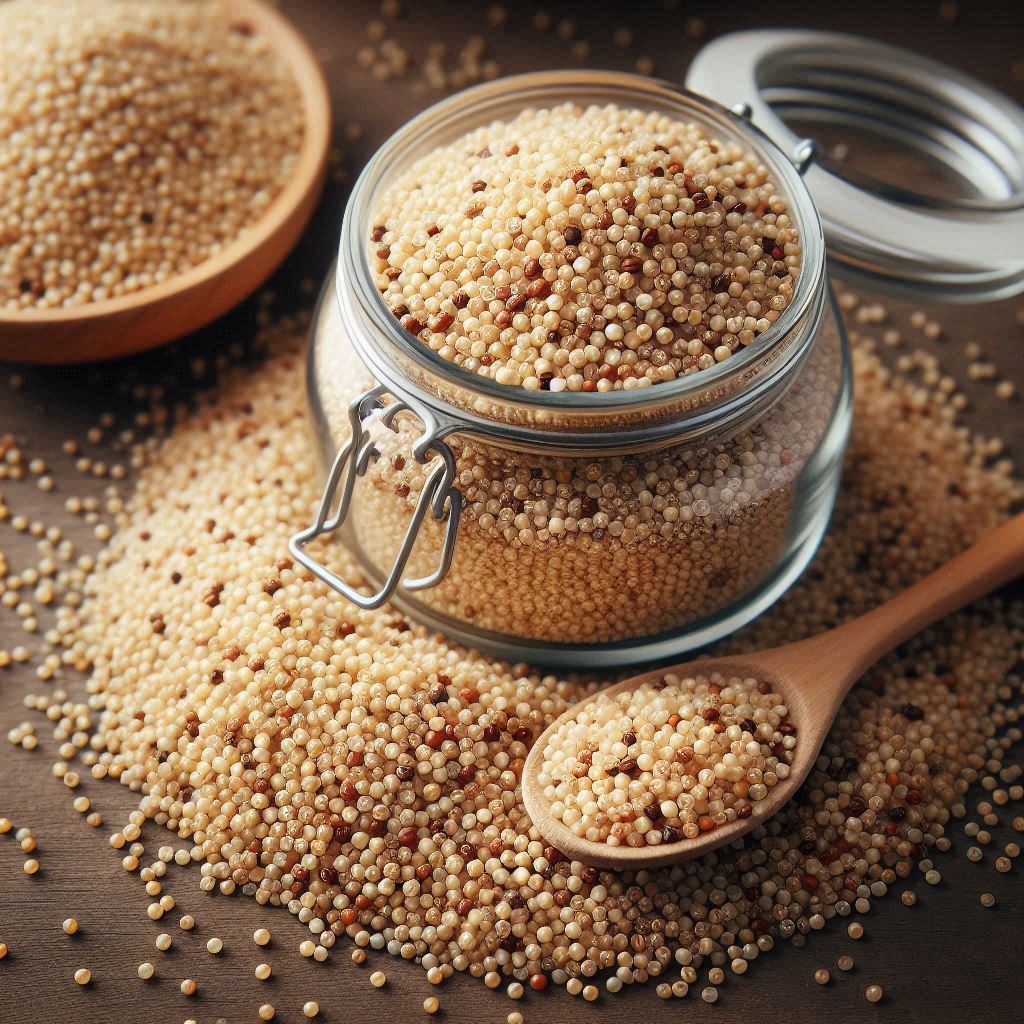
Non-hybrid grains, often referred to as traditional, heirloom, open-pollinated, or landrace grains, are varieties that reproduce naturally. When farmers save seeds from these plants and replant them, the next generation generally retains the characteristics of the parent crop.
These grains have often been cultivated and selected over hundreds or even thousands of years, adapting to local climates, soils, and growing conditions.
Examples include traditional varieties of:
- Fonio
- Teff
- Kamut
- Ancient wheats such as einkorn, emmer, and spelt
Many traditional farming communities throughout Africa, Asia, and the Americas relied on these grains long before the rise of industrial agriculture.
What Are Hybrid Grains?
Hybrid grains are produced by intentionally crossing two different parent varieties to create offspring with specific desirable traits. Plant breeders may select for:
- Higher yields
- Uniform growth
- Faster maturity
- Disease resistance
- Drought tolerance
- Improved storage characteristics
Hybrid corn is perhaps the most widely known example, but hybrid varieties also exist for sorghum and other crops.
While hybrid seeds can produce vigorous plants, the seeds saved from hybrid crops often do not reproduce consistently in subsequent generations. As a result, farmers frequently purchase new seeds each planting season.
The Question of Seed Sovereignty
One of the most significant differences between traditional and hybrid grains is seed sovereignty.
Traditional grains allow farmers to save, exchange, and preserve seeds. This practice has been fundamental to agriculture throughout human history.
Hybrid systems often create dependence on commercial seed suppliers because saved seeds may not produce the same results as the original crop. For many small farmers, this raises concerns about long-term agricultural independence and food security.
Nutritional Considerations
Some studies have found that certain traditional grain varieties contain higher levels of minerals, antioxidants, and other beneficial compounds compared with some modern commercial varieties.
The African Biomineral Balance also acknowledges that the nutritional value of food is closely connected to the mineral quality of the soil in which it is grown. A grain grown in depleted soil may contain fewer nutrients regardless of whether it is hybrid or non-hybrid.
Flavor and Traditional Food Culture
Many people who consume traditional grains report that they offer richer flavors and more distinctive textures than highly standardized commercial varieties.
Traditional grains are often deeply connected to cultural heritage and ancestral food practices. Across Africa, grains such as kamut, teff, fonio, and teff have nourished communities for generations and remain important components of traditional diets.
Preserving these grains helps maintain not only biodiversity but also cultural identity and food traditions.
Agricultural Diversity Matters
One concern frequently raised by advocates of traditional agriculture is the reduction of crop diversity.
When agriculture becomes heavily dependent on a limited number of commercial varieties, food systems can become more vulnerable to disease outbreaks, climate challenges, and changing environmental conditions.
Traditional grain varieties contribute to genetic diversity, which can help strengthen resilience within agricultural systems.
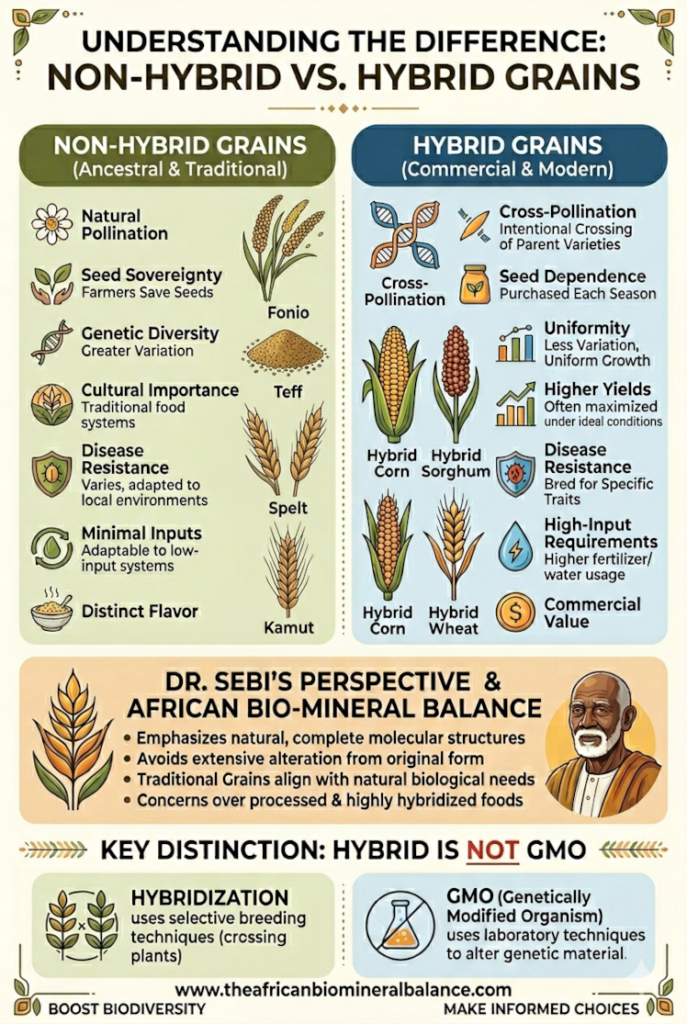
Hybrid Does Not Mean GMO
Many people confuse hybrid crops with genetically modified organisms (GMOs), but they are not the same.
Hybridization involves crossing plants through selective breeding methods.
Genetic modification involves laboratory techniques that directly alter genetic material.
A grain may be:
- Non-hybrid and non-GMO
- Hybrid and non-GMO
- In some cases, both hybrid and genetically modified
Understanding this distinction is important when evaluating modern food production systems.
The African Biomineral Balance Perspective
The African Biomineral Balance encourages a return to foods that are as close to nature as possible. Traditional grains often align with this teaching because they have been cultivated, selected, and preserved through generations of natural adaptation rather than intensive industrial development.
Many traditional African grains are naturally resilient, nutrient-dense, and well suited to local growing conditions. They represent a valuable part of Africa’s agricultural heritage and offer an alternative to increasingly standardized global food systems.
While hybrid grains may provide advantages in commercial agriculture, preserving traditional grain varieties helps support biodiversity, seed sovereignty, cultural heritage, and the continued availability of naturally adapted food crops.
Final Thoughts
The discussion surrounding non-hybrid and hybrid grains is not simply about farming techniques. It is also about food quality, biodiversity, cultural preservation, agricultural independence, and our relationship with the natural world.
As consumers become more interested in where their food comes from, traditional grains are receiving renewed attention. Whether grown in African villages, community gardens, or small farms around the world, these ancient crops continue to provide nourishment while connecting us to agricultural traditions that have sustained humanity for millennia.
By understanding the differences between hybrid and non-hybrid grains, we can make more informed choices about the foods we grow, purchase, and consume.

References / Suggested Readings
Here is a curated list of academic, botanical, and historical reference categories that validate the comparison between ancestral (non-hybrid) and commercial (hybrid) grains:
1. Botanical & Genetic Architecture References
- Open-Pollination vs. Hybridization Mechanics: Allard, R.W. Principles of Plant Breeding. John Wiley & Sons. This text outlines the structural genomic differences between open-pollinated landraces (ancestral grains) and controlled F1 hybrids, specifically addressing how parental inbred lines alter genetic uniformity.
- Molecular Structure & Stability: Native and heirloom grains maintain stable, adaptive genetic loops over generations. For foundational research on crop genetics and the conservation of ancestral crop varieties, see the FAO (Food and Agriculture Organization) reports on Plant Genetic Resources for Food and Agriculture.
2. Specific Ancestral Grains Profiles
- Kamut (Khorasan Wheat): Derived from ancient Egyptian lineage, pure Khorasan wheat is an unhybridized, open-pollinated ancient grain protected against modern commercial dwarf-wheat breeding methods.
- Spelt & Tef/Teff: National Research Council. Lost Crops of Africa: Volume I: Grains. National Academies Press. This historical text details the resilience, adaptation, and nutritional density of indigenous, low-input African grains like Teff and Fonio.
- Fonio (Digitaria exilis): Recognized as one of Africa’s oldest cultivated ancient grains, valued for its ability to thrive in poor soils without chemical fertilizers.
3. Seed Sovereignty & Agricultural Economics
- The Commercial Seed Loop: Shiva, Vandana. Stolen Harvest: The Hijacking of the Global Food Supply. South End Press. This document addresses the socioeconomic shift from traditional seed-saving (sovereignty) to commercial dependence caused by hybrid seed systems that do not reproduce “true-to-seed” in subsequent generations.
- Biodiversity Degradation: IPES-Food (International Panel of Experts on Sustainable Food Systems). From Uniformity to Diversity. This study details how shifting from diverse ancestral landraces to uniform hybrid commercial monocultures leaves global food systems vulnerable to environmental stress.
4. Holistic & Bio-Mineral Balance Philosophy
- Alkaline & Natural State Foundations: Beckford, Julie. Dr. Sebi’s African Biomineral Balance: An Alkaline Approach to Nutrition & Healing (2024). This guide formalizes the dietary framework regarding original, uncompromised plant structures, biological compatibility, and the avoidance of chemically or intensively hybridized foods to support systemic cellular health.